The CTC Technology Centre has successfully validated innovative conductive materials that are
effective in mitigating damage caused by electrostatic charge build-up on components of space
systems. The study concludes that the selected commercial coatings, notable for their high
transparency and electrical conductivity, are excellent candidates for use in photovoltaic cells
within the design of thermal control satellites.
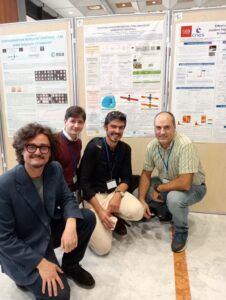
This work, entitled ‘Charging Effects Mitigation Using Innovative Conductive Materials’, was officially presented in the poster section of the 16 th edition of the International Symposium on Materials in the Space Environment (ISMSE), held from 7 to 11 October in Saint Raphaël,
France. This event is a reference for the latest research and results from scientists and engineers in materials for space applications.
The research is part of a project funded by the European Space Agency, in which CTC collaborates with the international engineering company ALTER Technology, leader of the consortium, the Spanish National Research Council [Consejo Superior de Investigaciones
Científicas], and DHV Technology, specialists in producing solar panels for the aerospace sector.
This initiative aims to develop new coatings with electrical properties designed to mitigate the
damaging effects of electrostatic charges. Specifically, the project focuses on three types of
electrically conductive coatings: transparent, white and black. The first two coatings are
designed to protect photovoltaic panels, while the black coating is intended for thermal
control of the devices or structures to which it is applied.
The analysis presented, involving Ángel Yedra, Lucía Pérez y Carla Ortiz, , focused on a
selection of commercial transparent conductive coatings designed for application on the roof
glass of photovoltaic arrays, alongside the development of electrically conductive coatings with
thermal control properties.
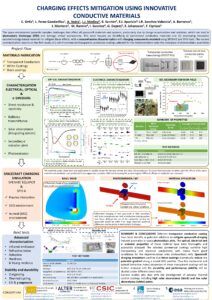
Simulations were conducted in two scenarios to analyse their performance under the effects of the space environment. First, their response was tested in an environment with characteristics specific to satellites in geostationary orbit (GEO) and then, their performance was assessed under conditions akin to those in auroral regions, which are areas of Earth’s atmosphere at high latitudes near the magnetic poles.
The characterisation and validation of these coatings in the laboratory were conducted according to very specific parameters established by the standards of organisations such as the European Space Agency (ESA) and NASA. Under these conditions, various properties, including electrical and optical, were analysed by simulating space conditions such as vacuum, temperature variations, and radiation. The results suggest that these materials offer potential solutions for mitigating the adverse and harmful effects of electrostatic charge accumulation in systems such as satellite and spacecraft photovoltaic units.
With this, the project can advance towards a more in-depth analysis of the mechanical and
optical properties of these coatings and assess their durability and stability of performance
under various stress tests.
It is worth mentioning that this marks the second initiative led by the European Space Agency
with direct involvement of the CTC Technology Centre. The Cantabrian Centre is also
developing a new methodology that will shorten the lifetime assessment time of batteries for
space applications.