The CTC Technology Centre collaborated with Reinosa Forgins and Castings to introduce a process that improves the efficiency of large steel rims quenching. By replacing the traditional injection nozzles in the quenching tanks with eductor mechanisms, the severity of the quenching process has increased by up to 70%, which enables the steel manufacturer to produce larger components while ensuring the homogeneity of hardness and enhancing the internal structure of each part.

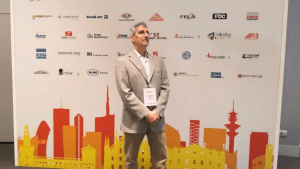
The study, entitled “Optimising Steel Block Quenching for Plastic Injection Moulds: A Simulation-Based Approach to Eductor-Enhanced Agitation“, was presented at the International Forgemasters Meeting in Milan. Roberto Báscones Vega, who leads this project at the CTC, attended the event and observed the presentation by Reinosa Forgings and Castings on this significant breakthrough, which opens the door to new capabilities for process control and optimisation opportunities.
Specifically, the team at the Technology Centre has been instrumental in developing simulation methods that predict the positive impact of this improvement on the product. Although the overall performance is not questioned, the effect of eductors on the water flow patterns and intensities becomes difficult to evaluate when installed inside such large tanks. In this instance, the focus is on a 300 m³ quenching tank equipped with a network of pressurised pipes featuring 208 nozzles (eductors), where both the water column and interferences from other objects become relevant.
To overcome this challenge, fluid dynamics and thermal models have been combined to compare the heat transfer coefficients on the block surface before and after the revamp. The system now incorporates innovative variables such as water velocity amplification through passive components, temperature monitoring using thermocouples installed at various depths and velocity verification through acoustic sensors. Thanks to this approach, the level of enhancement achieved can be accurately assessed with minimal deviation between theoretical predictions and empirical results.
This advance in process capabilities places Reinosa Forgings and Castings in a favourable position to meet the demands of the evolving plastic injection moulding market. Today, the shift towards vehicle electrification requires larger plastic injection moulds in response to the latest industry trends. This development requires the forges to increase the size of the rims while maintaining an excellent microstructure and homogeneity of hardness. Meeting these specifications proves increasingly challenging for larger components, where slower cooling rates in the core can produce soft microstructures.
This research, spearheaded by Reinosa Forgings and Castings, addresses these issues through a combination of water flow and heat flux modelling that significantly influences quench severity. It also exemplifies how the CTC team can become an essential technological partner for Cantabrian companies, enhancing the quality of their innovative projects.